
Radiology
The Radiology department at Cheyenne County Hospital is a fully digital department that provides advanced technology to provide physicians with a clear image for better diagnosis. Our experienced staff are licensed technologists available for your routine and emergency needs.
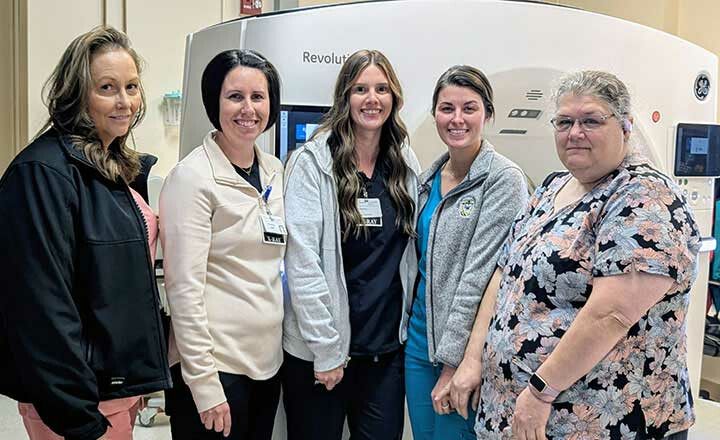
Fully digital services include a Full Digital X-ray room and a Full Digital mobile x-ray unit. The GE Revolution Maxima 64 slice has expanded our imaging capabilities exponentially for CT scans. Offering faster exam times, more protocols, metal reduction, lower doses, and better image quality.
Radiology Hours: Monday-Friday from 7 a.m.-5 p.m. and on emergency call 24/7. For more information call 785-332-2104 and ask for Radiology.
Services Offered
X-Ray Imaging
Cheyenne County Hospital went fully digital in X-ray in 2024 when they put in a brand-new Samsung GC85 x-ray system and a GM85 Digital portable machine. Digital radiography is an X-ray imaging method that uses electronic sensors to capture images, replacing traditional films. It allows for the immediate viewing, storage, and electronic transfer of high-resolution images, which can be manipulated for better visibility, shared more easily, and can reduce radiation exposure. With this capability we are able to provide patients with less radiation dose, faster can times, and better image quality.
CT Scans (CAT)
In 2021 Cheyenne County Hospital upgraded to a GE Revolution Maxima 64 multi slice CT scanner. A multi-slice CT scanner is an advanced medical imaging device that uses a continuous, rotating X-ray beam and multiple rows of detectors to acquire numerous thin cross-sectional images (or "slices") of the body simultaneously in a single rotation. These individual slices are then processed by a powerful computer to create highly detailed two-dimensional and three-dimensional (3D) views of internal organs, bones, soft tissues, and blood vessels. Computerized Tomography allows doctors to diagnose and treat a variety of conditions earlier and faster than ever before. Using specialized equipment and expertise to create and interpret CT scans of the body, Radiologist can more easily diagnose problems such as cancers, cardiovascular disease, infectious disease, trauma and musculoskeletal disorders.
The Revolution Maxima’s AI-based Auto Positioning automates patient positioning to help ensure each scan is as comfortable as possible for patients and optimized to provide you with the exact dose and imaging consistency you needed. This allows for faster scan times, amazing image quality, and lower radiation dose for our patients.
Mammography
Our Mobile Mammo service provided by United Radiology provides us with high quality Digital mammography every other month. Digital mammography with tomosynthesis, or 3D mammography, is a medical imaging technology that takes multiple X-ray images of the breast from different angles to create a 3D image. Digital Mammography allows for better cancer detection compared to standard 2D mammography. While the procedure is like a standard 2D mammogram, the difference lies in how the images are captured and analyzed.
DEXA scans (Osteoporosis)
To detect osteoporosis accurately, doctors use an enhanced form of x-ray technology called dual-energy x-ray absorptiometry (DXA or DEXA). DEXA bone densitometry is today’s established standard for measuring bone mineral density (BMD). DEXA is a quick, painless procedure for measuring bone loss.
Osteoporosis involves a gradual loss of calcium, causing the bones to become thinner, more fragile and more likely to break. The DEXA test can also assess your risk for developing fractures. It is recommended that on the day of the exam, eat normally, but don’t take calcium supplements for at least 24 hours beforehand.
The DEXA scan can be done via a mobile truck that comes to Cheyenne County Hospital, just visit with your provider.
MRI
New GE Signa Voyager Scanner offered at Cheyenne County Hospital.
Nuclear Medicine
Front Range Nuclear Medicines mobile unit is available at Cheyenne County Hospital on scheduled dates. Nuclear Medicine involves the use of small amounts of radioactive materials (or tracers) to help diagnose and treat a variety of diseases. Nuclear Medicine determines the cause of the medical problem based on the function of the organ, tissue or bone.
As an integral part of patient care, nuclear medicine is used in diagnosis, management, treatment and prevention of serious diseases. Nuclear Medicine imaging procedures often identify abnormalities very early in the progression of a disease–long before some medical problems are apparent with other diagnostic tests. This early detection allows a disease to be treated early in its course when there may be a more successful prognosis.
For information specific to type of study, go to Front Range Nuclear Services. The website provides helpful information regarding proper patient preparation and other information about the services offered through our nuclear medicine provider.
Nuclear medicine is a subspecialty within radiology. It comprises diagnostic examinations that result in images of body anatomy and function. The images are developed based on the detection of energy emitted from a radioactive substance given to the patient, either intravenously or by mouth. Generally, radiation to the patient is similar to that resulting from standard x-ray examinations.
Nuclear medicine images can assist the physician in diagnosing diseases. Tumors, infection and other disorders can be detected by evaluating organ function. Specifically, nuclear medicine can be used to:
- Analyze kidney function
- Image blood flow and function of the heart
- Scan lungs for respiratory and blood-flow problems
- Identify blockage of the gallbladder
- Evaluate bones for fracture, infection, arthritis or tumor
- Determine the presence or spread of cancer
- Identify bleeding into the bowel
- Locate the presence of infection
- Measure thyroid function to detect an overactive or underactive thyroid